Stock market today: Asian shares fall over China-US jitters following Biden's meeting with Xi
Nov 15, 2023
Asian shares have retreated after Wall Street added a bit more to its big rally from a day before
BANGKOK (AP) — Asian shares have retreated after Wall Street added a bit more to its big rally from a day before, while U.S. futures and oil prices were lower.
Any lift in sentiment from a
meeting between U.S. President Joe Biden
and Chinese leader Xi Jinping appeared to fade after Biden, pressed by a reporter on whether he trusted Xi, said he believed in trusting but verifying and conceded that China’s leader is a dictator.“He is a dictator in a sense,” Biden said.
Biden and Xi emerged from their first face-to-face meeting in a year vowing to stabilize the fraught relationship between the world's two biggest economies. They showcased modest agreements to combat illicit fentanyl and re-establish military communications. Rifts on economic competition and global security threats persist, but
Biden said they agreed
to “pick up the phone” and talk if urgent issues arise.Hong Kong’s Hang Seng lost 1.2% to 17850.33 and the Shanghai Composite index was down 0.5% at 3,056.09.
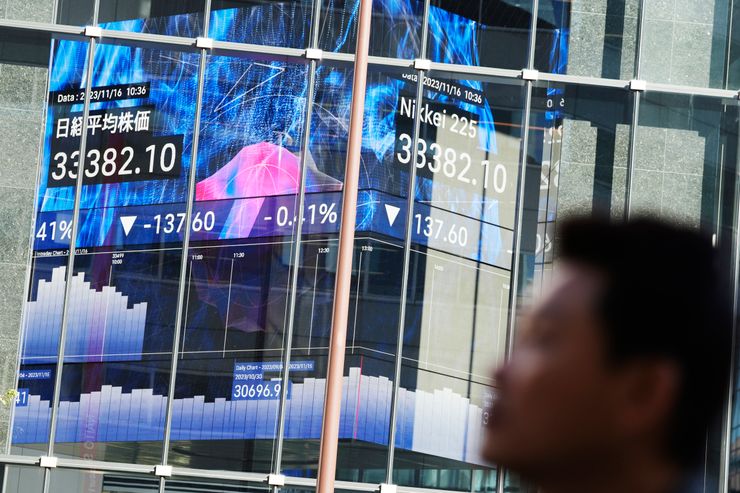
In other Asian trading, Tokyo's Nikkei 225 shed 0.2% to 33,445.08 and the Kospi in Seoul edged 0.1% lower, to 2,486.33.
In Australia, the S&P/ASX 200 sank 0.8% to 7,051.20.
Japan reported
that its exports rose a meager 1.6% in October, down from a 4.3% increase in September, while its trade deficit shrank 70% thanks to a 12.5% decline in imports as oil prices fell. The figures augur further weakness for Japan's export manufacturers after theeconomy contracted at a 2.1% annual rate
in the July-September quarter.Shares rose in India, but fell in Bangkok.
On Wednesday, the S&P 500 rose 0.2% to 4,502.88. The Dow Jones Industrial Average gained 0.5% to 34,991.21, and the Nasdaq composite edged up by 0.1% to 14,103.84.
Target
helped lead the market with a 17.8% jump after it reported much stronger profit for the latest quarter than analysts expected.Wall Street’s overall moves were tentative coming off its best day since April, when
an encouraging report on inflation
boosted investors’ hopes that the Federal Reserve may finally be done with its hikes to interest rates. That bolstered hopes the Fed can actually pull off the balancing act of getting inflation under control without causing a painful recession.Halfway through November, the S&P 50 has already jumped 7.4%, which would make this its best month in a year if it does nothing else for two weeks.
Treasury yields rose Wednesday, retracing a bit of the steep drops from the day before that had helped stocks to rally so much. The yield on the 10-year Treasury climbed to 4.53% from 4.45% late Tuesday, adding some pressure onto financial markets.
Another report on inflation Wednesday came in lower than expected.
Prices at the wholesale level were 1.3% higher
in October than a year earlier, and they surprisingly fell from September’s levels. That breathed more life intohopes that inflation is indeed cooling
enough for the Fed to halt its barrage of rate hikes.A separate report showed sales at U.S. retailers
fell 0.1% in October
from September, holding up better than the 0.3% drop forecast by economists.Traders on Wall Street have built expectations that the Fed could begin cutting rates as soon as the summer following the recently encouraging data on inflation. That's despite officials at the Fed saying that they will likely keep interest rates high for a while in order to ensure the battle is definitively won against inflation.
Strategists at Goldman Sachs led by Praveen Korapaty are warning the market's expectations for rate cuts by major central banks around the world are “too large and too early,” while adding that even if rates are heading lower, they will not be as low as they were before.
In other trading, U.S. benchmark crude oil gave up 61 cents to $76.06 per barrel in electronic trading on the New York Mercantile Exchange. It lost $1.60 to $76.66 on Wednesday.
Brent crude, the international standard, declined 70 cents to $80.48 per barrel.
The U.S. dollar fell to 151.32 Japanese yen from 151.38 yen. The euro slipped to $1.0840 from $1.0848.
___
AP Business Writer Stan Choe contributed.




A Tale of Two Cities, retold in style
Oct 21, 2026